



SUSTAINABILITY MANAGEMENT
I-ne is committed to fulfilling our mission statement:We are Social Beauty Innovators for Chain of Happiness.
General Sustainability Policy
I-ne Group’s General Sustainability Policy is predicated upon our mission statement: We are Social Beauty Innovators for Chain of Happiness. When we speak of the “chain of happiness,” we mean the following: Our products and services create value for the customer, sparking a sustained chain reaction of happiness in which the happiness spreads to people around the customers and then outward to the wider community and environment.
According to this way of thinking, sustainability is not something we engage in separately from our business commitments. Indeed, sustainability must be a foundational part of our business if we are to serve our mission. Our business activities, as well as creating immediate benefits, must leave lasting positive impacts for communities and the environment.
To that end, we work to balance business growth with a commitment to action on socioenvironmental themes such as climate-related action, responsible procurement, circular economy, biodiversity, human rights, employee well-being, and community engagement. Our commitment to these socioenvironmental themes is on a continuum with our business activities and forms the basis upon which we spread the chain of happiness to people everywhere.
Driven by our mission, we will continue to engage in business activities that spread the chain of happiness among customers, communities, and the environment, making a more sustainable world for all.
Organizational Framework for Sustainability
In January 2022, we established an organizational framework to facilitate action on material sustainability themes.
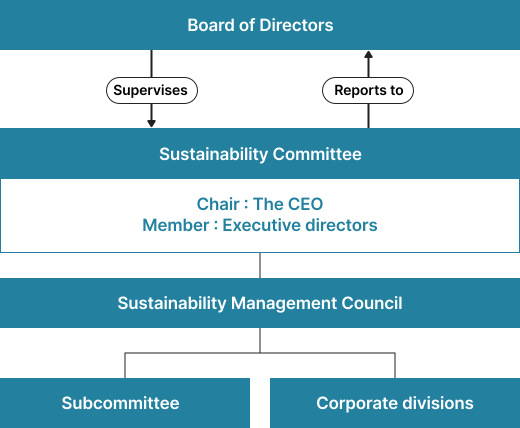
One part of this is the Sustainability Committee, which operates directly under the Board of Directors and is chaired by the President and CEO. The committee’s membership comprises executive directors, outside directors, members of the Supervisory Committee, and executive officers (division managers). The committee helps the Board of Directors discharge its monitoring function by setting sustainability goals, monitoring progress toward these goals, and by assessing and managing sustainability-related risks and opportunities. Important agenda items are subject to the approval of the Sustainability Committee and the Board of Directors.
The secretariat of the Sustainability Committee is the Sustainability Management Council, which comprises subcommittee representatives and division managers. This council deliberates on identified risks and opportunities. During its monthly meetings, division managers, each acting as sponsors to a subcommittee, update the Chief Sustainability Officer about their progress toward goals for material sustainability themes.
The Sustainability Management Council is attended by the heads of the relevant divisions, who then report the proceedings to the other division managers during a monthly management meeting (attended by persons holding the rank of division manager or higher) to ensure that there is clarity across the organization about the latest developments in the sustainability strategy. Specific initiatives are approved by the Sustainability Committee. Once an initiative is approved, directives will be issued as necessary to division staff during a management meeting attended by the relevant executive officers or division managers. Division staff will use KPIs to track progress in the initiative. Progress will also be monitored by the Sustainability Committee twice a year. The findings are reported to the Board of Directors. When a problem emerges, this close collaboration enables the senior management make swift decisions and establish the right project structures for addressing the problem.
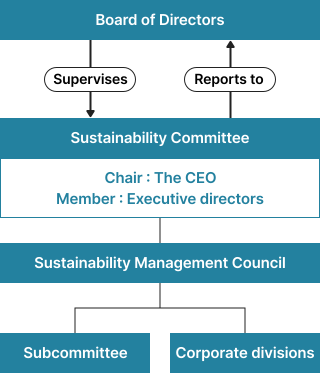
▼ Organizational Framework for Sustainability
Disseminating Sustainability Within the Organization: Nurturing Social Beauty Innovators
Alongside sustainability actions, we nurture employees into Social Beauty Innovators—innovators who create positive social impacts. For example, we run training programs to raise employees’ awareness about socioenvironmental issues, keep employees updated on the latest socioeconomic developments, and provide opportunities for employees to give back to communities.
■ Video-Based Educational Content with a Liberal Arts Focus
We have developed video-based educational content for employees so that employees will have a common understanding of the material sustainability themes. The content is taught in a program that both new and long-serving employees are required to attend.
■ Ethical Concierge Course
In 2021, we adopted the Ethical Association’s Ethical Concierge program, in which attendees learn and discuss the fundamentals of ethical citizenship. As of December 2025, a cumulative total of 414 (85%) of employees have enrolled into the program.
Materiality Identification Process
The material issues in the table above represent our strong commitment, as Social Beauty Iinnovators (innovators who strive to transform our society for the better), to make a positive impact. In 2021, we identified the key material issues we should focus on, considering the latest societal trends and stakeholder expectations. We will continue to regularly revise the set of material issues in response to social changes and business growth.
In setting and verifying these material issues, we follow the concept of double materiality,considering both the social and environmental impacts of our business activities, as well as the impacts of social and environmental factors uponthat affect our upon competitiveness and value creation.
-
Identification of Societal Issues
With reference to GRI Standards, SASB (Sustainability Accounting Standards), and SDGs (Sustainable Development Goals), we identified social issues to consider.
-
Organize "Stakeholder’s priorities"
Based on the identified social issues, we have organized hypotheses regarding the expectations and demands of our customers, business partners, investors, public administration, and NPO/NGOs towards the I-ne Group.
-
Organize "Company’s priorities”
Based on the social contribution activities that the I-ne Group has engaged in so far and the brand MISSION upheld by our main brands, we have aligned the priorities of the I-ne Group with the priorities of our stakeholders.
While the I-ne Group recognizes that governance is certainly important for a listed company, it is not included in the Materiality.
Instead, it is structured in the Environment and Social category. -
Approval by management
After discussions amongst the management committee, validation by the Sustainability Committee, and resolution by the Board of Directors, we have identified the materiality.
The materiality of I-ne Group
-
Net zero
-
Responsible Procurement and Transparency
-
Circular Economy
-
Forest and Water Conservation
-
Well-being and Inclusion
-
Poverty and Inequalities
Materiality and Goals of the I-ne Group
The table below shows our six material issues (issues that matter to society and our organization) and the medium- and long-term targets linked to these issues. We have revised or removed certain goals as we advance our strategy and the roadmap to achieve our goals becomes more concrete. We will continue to revise or add goals as necessary moving forward.
| Material issue | Goal | KPI | Target | Target year | Result in 2025 |
|---|---|---|---|---|---|
| 1.Net Zero | Scopes 1 and 2: Reduce GHG emissions from offices and retail locations1 | % reduction | 46.2%10 | 2035 | To be announced |
| Scope 3: Reduce supply chain2 GHG emissions1 | % reduction | 31.73%11 | 2035 | To be announced | |
| Net Zero3 | - | - | 2050 | To be announced | |
| 2.Responsible Procurement and Transparency | Sourcing transparency: Identify the countries of origin and associated risks for plant-based ingredients used by key brands4 | % with transparent sourcing | 100% | 2025 | Country of origin identified in 44.9% of plant-based ingredients |
| Sourcing transparency: New brands to conform with I-ne’s Sustainable Product Development Standards | % of target | 100% | 2030 | 100% | |
| 100% transition to certified sustainable palm oil (either physically sustainable or offset under the Book & Claim scheme) |
% of palm oil that is certified | 100% | 2030 | 31%13 14 | |
| 3.Circular Economy | Sell applicable secondhand cosmetic products on the beauty resale market | % sold on beauty resale market | 100% | 2026 | 100% |
| Decrease use of virgin plastics in containers and packaging5 | % reduction | 50%12 | 2030 | To be announced | |
| Cosmetics products to use containers and packaging made of recyclable materials | % of cosmetics products using such | 15% | 2030 | This is a new goal, so the result will be announced in March 2027 | |
| Use sustainable paper (paper that is certified or recycled)6 | % of cosmetics products using such | 100% | 2030 | 100%14 | |
| 4.Forest and Water Conservation | Engage in forest conservation | Project area | 50ha | 2028 | 13ha Sustainably Managed Natural Site |
| 5.Well-being and Inclusion | Ensure employee engagement | Engagement score | 4.0 | 2030 | 3.87 |
| Ensure employee well-being | % of respondents giving highest or second highest score8 for well-being7 | more than 50% | 2030 | 32.3% | |
| Establish employee volunteer program and encourage participation in it | Annual number of employees participating | 800 | 2025 | 728 | |
| Employees volunteering at least once a year | % of employees doing so | 80% | 2030 | This is a new goal, so the result will be announced in March 2027 | |
| Employees volunteering at least twice a year | % of employees doing so | 60% | 2030 | This is a new goal, so the result will be announced in March 2027 | |
| 6.Poverty and Inequalities | Support people in financial distress | Cumulative direct reach9 | 30,000 | 2030 | 5,246 |
1 The target has been changed to make it science-based.
2 Supply chain emissions are emissions other than those from offices and retail locations (scopes 1 and 2).
3 The target year has been changed.
4 “Key brands” refers to the set of stock keeping units that account for at least 80% of sales.
5 The goal was achieved, so the target year and target have been changed.
6 The coverage has been extended and target year have been changed.
7 This is the score on a well-being scale developed by Persol Research and Consulting Co., Ltd., and Takashi Maeno’s office at Keio University.
8 The top two scores are “agree strongly” and “agree.”
9 “Cumulative direct reach” indicates the total number of individuals reached between 2025 and 2030.
10 For scope 2 emissions, we use market-based reporting. Percent change is in comparison to the level in 2024.
11 Percent change is in comparison to the level in 2024.
12 Stated differently, the target for 2030 is for virgin plastics to account for less than 50% of the total plastic in containers and packaging shipped by I-ne.
13 This is an estimate based on the palm oil–derived materials used in key rinse-out and leave-in products.
14 This result does not include group companies.